Whether a suppressor (also called a silencer) needs cleaning comes down to the ammunition going through it and how it was built to handle what that ammunition leaves behind. Centerfire rifle suppressors mostly maintain themselves, rimfire suppressors foul quickly and need regular attention, and pistol suppressors sit between the two. That split is the reason cleaning advice varies so much from one owner to the next. The sections below cover why the split exists, what carbon lock is and how to prevent and undo it, which cleaning methods are safe for which materials, and when it's actually time.
Centerfire rifle suppressors mostly maintain themselves
The pressure does most of the work. A centerfire rifle cartridge like 5.56 NATO pushes gas through the suppressor hot enough and fast enough that most fouling burns off or blows out with each shot rather than stacking up. SilencerCo describes its centerfire designs as largely self-cleaning for this reason and says its welded suppressors are built to run a lifetime of rounds with no cleaning at all (SilencerCo, manufacturer guidance). GSL Technology goes further in its owner's manuals, stating that it doesn't recommend cleaning at all and that its suppressors are designed for tens of thousands of rounds without it.
Some fouling even helps. SilencerCo notes that a brand new suppressor tends to sound a little louder than one with some carbon in it, and that the light residue a centerfire rifle suppressor retains has no meaningful effect on weight or balance (SilencerCo, manufacturer guidance). Unjacketed or dirty ammunition is the exception the same guidance flags: it can add ounces of fouling to a suppressor that would otherwise stay light. And whatever the caliber, the threads and mount keep collecting residue, which is where carbon lock starts.
Why rimfire suppressors get filthy
The ammunition is the reason. A .22 LR bullet is soft lead carrying a wax lubricant, the propellant burns dirty, and pressure runs far below centerfire levels, so the gas lacks the energy to scour anything out. Lead vaporized at the muzzle condenses on the baffles, the stack of cone-shaped partitions inside the suppressor that trap and slow the gas, and mixes with carbon into a crust that keeps thickening. The suppressor gains weight, and standard carbon solvents won't dissolve the lead fraction, so rimfire cleaning depends on soaking and mechanical removal.
Designers plan for this. Unlike sealed models, which are welded shut, rimfire suppressors are generally built to be taken apart for exactly this kind of maintenance (Silencer Shop, retailer guidance). How fast the crust builds varies with ammunition and design, and that variation is one reason published cleaning intervals disagree so widely.
Pistol suppressors land in the middle
Jacketed 9mm doesn't shed bare lead the way .22 LR does, but pistol pressures sit well below rifle levels, and the fouling stays. SilencerCo's guidance for its Octane 9 pistol suppressor is disassembly and cleaning every 500 rounds, or any time it's fired wet, meaning with water or gel added inside to quiet the first shots (SilencerCo, manufacturer guidance).
The mount needs the most regular attention. Many pistol suppressors attach through a booster, a spring-loaded piston that lets a tilting pistol barrel cycle under the added weight, and carbon inside that assembly drags on the action. Silencer Shop recommends periodic booster and piston service on top of a light cleaning every few thousand rounds (Silencer Shop, retailer guidance).
How carbon lock happens
Carbon lock is what it sounds like: carbon packs into a joint, heat cycles bake it hard, and the parts on either side end up cemented together. It can form between any of the parts around the muzzle: barrel and muzzle device, meaning a brake or flash hider, muzzle device and suppressor, or either side of a mount, the adapter some suppressors use in between. A direct-thread suppressor screwed straight onto the barrel's threads is the classic picture, and quick-detach systems, which latch the suppressor onto a muzzle device across tapered surfaces, can lock up too.
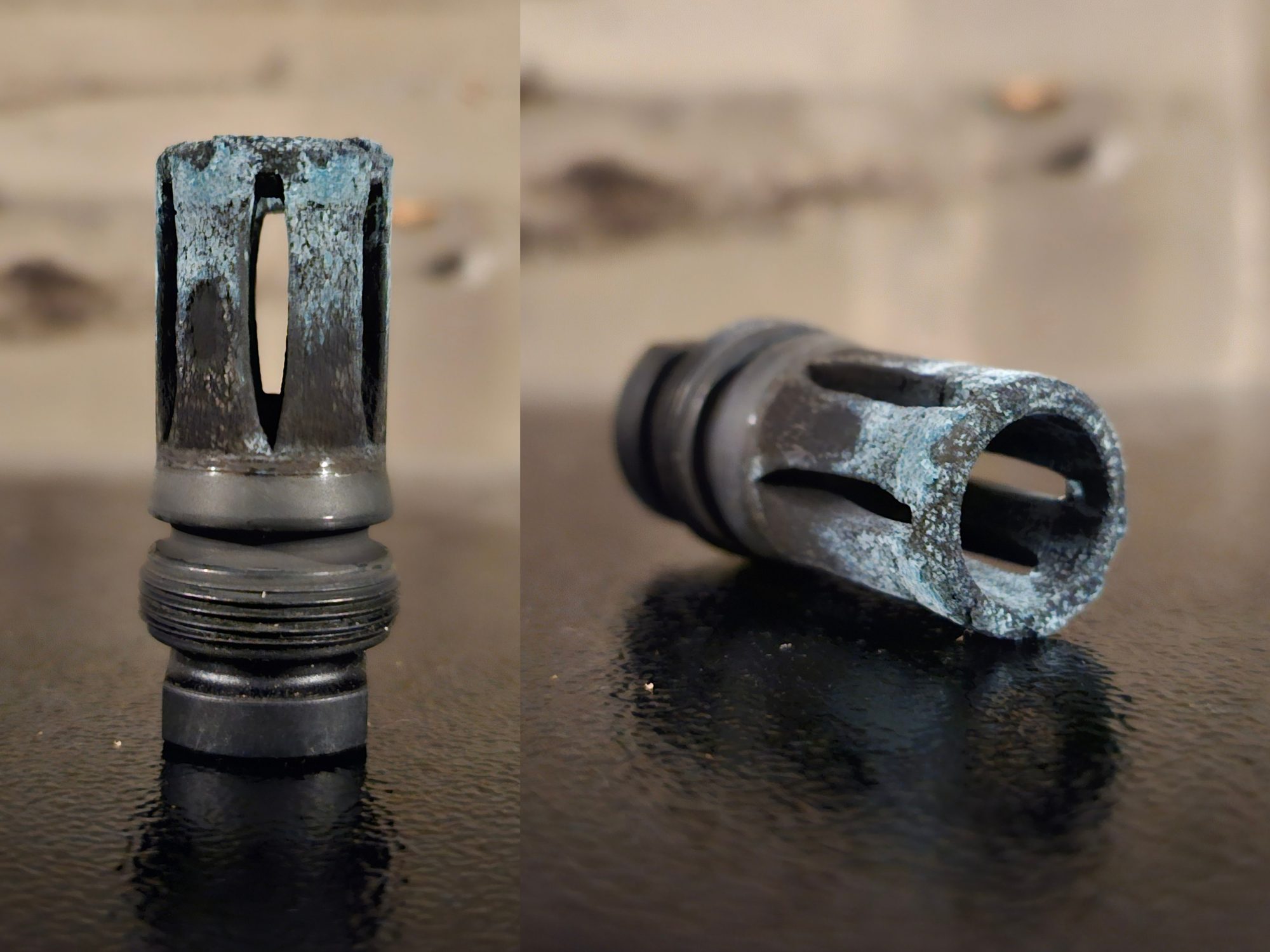
Prevention is habit. Break the suppressor loose at the end of a session instead of leaving it mounted for months, and keep the threads clean. Even the timing draws conflicting guidance: Rugged recommends letting a suppressor cool to ambient temperature before changing hosts or configurations (Rugged, manufacturer guidance), while Brownells' advice is to remove one while it's still warm but not extremely hot (Brownells, retailer guidance). Your manual settles the timing for your model. GSL's manuals suggest 0000 steel wool (the finest common grade) or a green scouring pad on the threads, cleaned only enough to mount and unmount easily, and warn against ammonia or water on the metal because both invite corrosion (GSL GT300K manual, manufacturer guidance). Mind the heat too: the same manuals put the temperature gain at roughly 7 to 10 degrees Fahrenheit per round fired and call for gloves when handling (GSL Game Changer manual, manufacturer guidance). Check the manual for your model before putting anti-seize or anything else on the threads.
For a suppressor that's already stuck, escalate gently. Rugged's published fix is penetrating oil, a thin oil made to creep into seized fittings, worked into and around the threads, a couple of minutes for it to soak, then about five rounds fired through the suppressor before trying removal again, with soft vise jaws and a strap wrench as the next step (Rugged, manufacturer guidance). Put a real wrench on the muzzle device's flats if it has them; GSL's GT300K manual lists a piece of soft wood or a soft rubber mallet among the removal tools (GSL GT300K manual, manufacturer guidance). Keep pipe wrenches and pliers off the tube itself. The walls are thin, and a crushed tube can shift a baffle into the bullet's path, which is how a baffle strike happens. If nothing moves, the manufacturer is the fallback: GSL, for one, takes suppressors back directly for warranty repair without routing the return through a dealer (GSL Game Changer manual, manufacturer guidance).
Sealed or serviceable: who does the cleaning
Construction decides whose job maintenance is. A sealed suppressor is welded closed, so getting inside means destroying it, and SilencerCo builds its welded models on the assumption they'll go uncleaned for life (SilencerCo, manufacturer guidance). A user-serviceable suppressor opens up instead: the end cap unscrews, the baffle stack slides out, and the cleaning is yours to do. GSL's manual for its user-serviceable Flea walks through that process with gloves on, in a spot where lead particulate won't cause problems, using a wooden dowel rather than a metal rod to push stubborn baffles free (GSL Flea manual, manufacturer guidance).
Sealed doesn't always mean hands-off, though, and manufacturers genuinely disagree about it. SilencerCo approves no solvents for its welded models and counts solvent cleaning as grounds for voiding its lifetime warranty (SilencerCo, manufacturer guidance). Silencer Central publishes the opposite for its sealed BANISH Speed K Ti: plug one end, fill it with dish soap or a solvent that won't harm the finish, soak for 24 hours, rinse, and let it dry completely before shooting (Silencer Central, manufacturer guidance). Check what your warranty says before soaking anything sealed. Repairs and wear parts stay factory territory either way: some designs seal around the bullet with wipes, soft discs the bullet punches through, which wear out with use, and GSL notes the ATF controls replacement wipes as suppressor parts, so the company swaps them in-house or through a dealer holding a manufacturing license (GSL, manufacturer guidance).
Cleaning methods that match the metal
Identify the metal before choosing the method. Aluminum keeps weight down and reacts badly to strong chemistry: acidic and caustic cleaners pit it and strip anodizing, its protective surface layer, and Silencer Shop's method chart rules aluminum out of most aggressive techniques (Silencer Shop, retailer guidance). Titanium tolerates far more. Thunder Beast tells owners of its all-titanium models to plug the suppressor, fill it with CLR, the household calcium and lime remover, and soak it for a few hours to overnight, while warning that CLR can discolor Cerakote, a common baked-on finish, and that its models containing stainless steel or Inconel, a heat-resistant nickel alloy, can't be cleaned with CLR at all (Thunder Beast, posted on Sniper's Hide, manufacturer guidance). A bath that's routine for one metal pits another, so the material listing on your model matters more than any general recipe.
For serviceable suppressors, three approaches cover most of it. A solvent soak is the baseline: submerge the baffles in a carbon cleaner, give it time, work the softened fouling off with nylon brushes and plastic picks, then let every part dry before reassembly; Silencer Central's don't list includes firing a suppressor with solvent still wet inside it (Silencer Central, manufacturer guidance). Wet tumbling is the mechanical route for rimfire baffles: a rotary tumbler loaded with stainless pins, water, and a little dish soap knocks lead off without chemistry. An ultrasonic tank, which scrubs parts with high-frequency vibration in heated solution, does well on stainless baffle stacks and sits on the unsafe side of Silencer Shop's chart for aluminum (Silencer Shop, retailer guidance). SilencerCo, for its part, treats vibratory tumbling as grounds for voiding its warranty (SilencerCo, manufacturer guidance).
One method to skip is the dip, a 50/50 mix of white vinegar and hydrogen peroxide. It strips lead fast by converting it into lead acetate, a compound that absorbs through skin and requires hazardous-waste disposal; it can't go down a drain (The Firearm Blog, press coverage; Silencer Shop, which calls it highly toxic and doesn't recommend it, retailer guidance). The broader lead rules apply to any rimfire cleaning session regardless of method: nitrile gloves, ventilation, fouling kept wet instead of scraped into dust, and washed hands afterward (Silencer Shop, retailer guidance).
Reassembly gets the same care as the chemistry. Baffle order and orientation matter, since a part out of place puts metal where the bullet goes, and SilencerCo suggests photographing each step of disassembly so the stack goes back exactly as it came apart (SilencerCo, manufacturer guidance).
Timing the cleaning
Published intervals disagree, and the disagreement is the lesson. Silencer Shop's general guidance for rimfire is every 300 to 500 rounds (Silencer Shop, retailer guidance), while SilencerCo puts its own rimfire suppressors at roughly every 1,500 rounds and recommends the Sparrow 22 be cleaned after 1,000 (SilencerCo, manufacturer guidance). The interval belongs to the model, so the manual for yours outranks any general figure, including the ones in this article.
Weight settles the question when round counts get fuzzy. Thunder Beast tells owners to weigh a suppressor new and clean it once it has gained an ounce, and offers a reference point of about 1,000 rounds of factory 6.5 Creedmoor producing that ounce in its Ultra 7 (Thunder Beast, posted on Sniper's Hide, manufacturer guidance). A kitchen scale turns "is it time yet" into a measurement: record the weight on day one and check it whenever the suppressor starts feeling or sounding different.
So, does yours need cleaning?
The advice conflicts at the range because each owner is answering honestly for their own hardware. Run jacketed centerfire ammunition through a welded suppressor and the answer is mostly no: keep the threads and mount clean, break the joint loose now and then, and leave the interior alone. Run .22 LR through anything and the answer is yes, on a schedule, with gloves on. Between those poles, the construction and materials of the specific model decide the rest, and the owner's manual has the final word. Those details are model-specific, and each suppressor's page on Baffled lists its materials, mount, and construction.